
Basic Principles of Silicon Detectors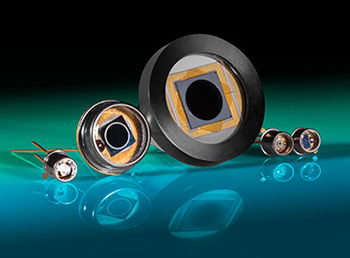
Through the photovoltaic effect, silicon detectors provide a means of transforming light energy to an electrical current. The root of the theory behind this phenomenon is a small energy gap between the valence and conduction bands of the detector. When light, with enough energy to excite an electron from the valence to the conduction band, is incident upon the detector, the resulting accumulation of charge leads to a flow of current in an attached circuit. Since light is not the only source of energy that can excite an electron, detectors will produce some amount of current that is not representative of incident light. For example, fluctuations in thermal energy can easily be mistaken for light intensity changes. A variety of these "non-light" contributions are present and, when summed up, make up the total noise within the detector. The ratio of the overall signal output to the noise level is known as the signal to noise ratio (S/N) and can be used to determine whether noise will be a concern for a particular application. While noise is certainly a key means of characterizing detectors, it is only one of the characteristics which should be considered when selecting a detector. Some key issues regarding detectors are outlined in the terms and definitions box below.

Different Operation Modes
Photovoltaic (unbiased): During photovoltaic (PV) operation, no external bias is applied to the photodiode. Since Dark Current is a function of bias magnitude, PV operation eliminates Dark Current as a source of noise. In this case, the NEP (or Noise Equivalent Power) will be lower, thereby allowing greater sensitivity at lower wavelengths. This makes it ideal for low signal detection. One disadvantage is the slightly lower responsivity at higher wavelengths (see graph).
Photoconductive (biased): During photoconductive (PC) operation, a reverse bias on the photodiode results in a number of response advantages, such as a faster rise time. This makes this type of operation more suitable for high frequency applications. One inconvenience is that the dark current increases with this applied biased current, so noise is introduced into the system.
Terms & Definitions
Responsivity (R): A measure of a detector's effectiveness in producing an electrical signal. The product of the light input (in Watts) and the responsivity result in the predicted output of the detector (in amps). Varies with temperature.
Detectivity (D): D is a measure of the detecting ability of the photodiode.
Capacitance (C): Also called the junction capacitance, is related to the rise time of the photodiode. The smaller the capacitance, the shorter the rise time, and vice versa.
Dark Current (Id): The current associated with a detector during operation in the dark with an applied reverse bias. Increased temperature and reverse bias will result in increased dark current. Also, larger active areas will generally have a higher dark current.
Breakdown Voltage (BDV): The voltage at which the detector begins to behave as a conductor.
Noise Equivalent Power (NEP): The incident light power required to produce a signal on the detector that is equal to the noise. In this case, the signal to noise ratio is equal to one.
Rise Time (Tr): The time necessary for a detector's output to go from 10% to 90% of its final value.
Saturation Current (Isat): Maximum level, above which the output current deviates 10% from linearity.
Shunt Resistance (Rsh): Is the effective resistance of the photodiode. It represents the slope of the I-V curve at the origin (V=0).
版權所有 © 2026 江陰韻翔光電技術有限公司 備案號:蘇ICP備16003332號-1 技術支持:化工儀器網 管理登陸 GoogleSitemap


